Part of students’ brains are shrinking, says education expert

Dr. Bill Daggett
By MICAH HENRY
Dr. Bill Daggett, Executive Chair and founder of the Successful Practices Network, brought some surprising research to light at Alexander Central Auditorium on Thursday, March 13. Dr. Bill Griffin, Alexander County Schools Superintendent, introduced the guest speaker.
Daggett’s appearance was underwritten by a grant from the Burroughs Wellcome Fund and Sam Houston. Daggett spoke to an audience of faculty, teachers, and parents at the event, noting that modern youths’ brains are developing differently, due to the increased screen time in their childhood, compared with youths of only 10 or 20 years ago.
View a video of Dr. Daggett’s presentation on the schools system’s YouTube Channel here: https://youtu.be/-EUC7F6QEvc?si=d5U4agOESvG44G4O
Daggett wrote a book on brain development with Paul D. Nussbaum, Ph.D., one of the nation’s leading neuroresearchers, entitled What Brain Research Teaches About Rigor, Relevance, And Relationships: And What It Teaches About Keeping Your Own Brain Healthy.
“Play-based childhood has been replaced by screen-based childhood,” he noted. “Screen-based childhood has led to sleep deprivation, social deprivation, and attention deficit.”
He noted that scans of youths’ brains have shown a smaller hippocampus region, which is the root of the prefontal cortex. The hippocampus is responsible for spatial memory, spatial navigation, mental mapping, short-to-long term memory. The prefrontal cortex is responsible for problem solving, organizational skills, ability to focus, resilience, and long-term memory.
He gave the example of how he navigated to the school Thursday — he flew to Charlotte, rented a car, and used GPS to find his way to drive to Taylorsville. He doubted he could name most of the towns he passed through between Charlotte and Hickory to arrive here. Only a few years ago, he would have had to navigate using a paper map.
“The brain is a muscle. If you don’t use it, you lose it,” Daggett explained. “Our hippocampuses are shrinking because we’re not using them. What’s the big deal? It’s responsible for those skills and memory. The thing that scares me, the technology that underpins GPS and other technologies are the same technologies that underpin the games the kids are on. Today’s kids’ hippocampuses are fraction of the size of the hippocampuses of kids’ brains ten and twenty years ago. Why? They’re never developing. Why does that become such a critical issue? Because the hippocampus is the foundation — the roots — of the prefrontal cortex, and the prefrontal cortex is responsible for those skills (problem solving, organizational skills, ability to focus, resilience, and long-term memory). Ask any classroom teacher in this country if they have seen an erosion in kids’ abilities in these four areas, and they say, absolutely.”
AI can do the predictable, Daggett related, but the unpredictable — the skills that are increasingly more important if parents want to children to become independent — those are the skills children are coming to school having diminished capacity in.
“What do we do in our schools to address this? What are the instructional practices we need to begin to use and maybe ultimately help parents understand better? The key to it is, you have to teach kids how to apply skills,” Daggett said. “If you learn how to apply, you retain it.”
He gave example that a carpenter probably learns more math and science doing carpentry than in any classroom — because he had to problem solve and use skills.
“But we’re not about that,” Daggett noted.
He played a video clip from Stanford’s Dr. Linda Darling-Hammond, who stated, “Inert knowledge, things that you memorize, spit back, and never use, does not stick. About 90 percent of the things you might take in, memorize, use on a test, and never use again disappear. You don’t have those usable in your brain later.”
Lawrenceville Academy asked returning students to retake their science finals just three months after having completed their courses. Faculty eliminated all low-level details from the final. The result? The average grade on these exams fell from a B+ to an F. Across two years and several courses, not one student still had command of all major concepts they had presumably mastered just three months earlier.
“This is not a curriculum issue,” Daggett said. “I’m not suggesting you change your curriculum. It’s about your instructional practices and designs.”
He said one class should have something to do with the next class and guide students to apply skills across disciplines on real-world problems that are not easily solved. He added that students should work as members of a team.
“These kids are really different in other ways,” Daggett said. He asked for a show of hands in the audience: how many, within one month of turning 16, got their driver license? Within the first day? Almost half raised their hands.
By contrast, only 56 percent of 2024 high school graduates, nationwide, on graduation day had obtained their driver license, compared to 87 percent in 2000.
The number of twelfth graders who had held a part-time job was 78 percent in 2000 but had fallen to only 43 percent in 2024.
High school graduates of 2024 who had dated was only 42 percent, compared to 79 percent in 2000.
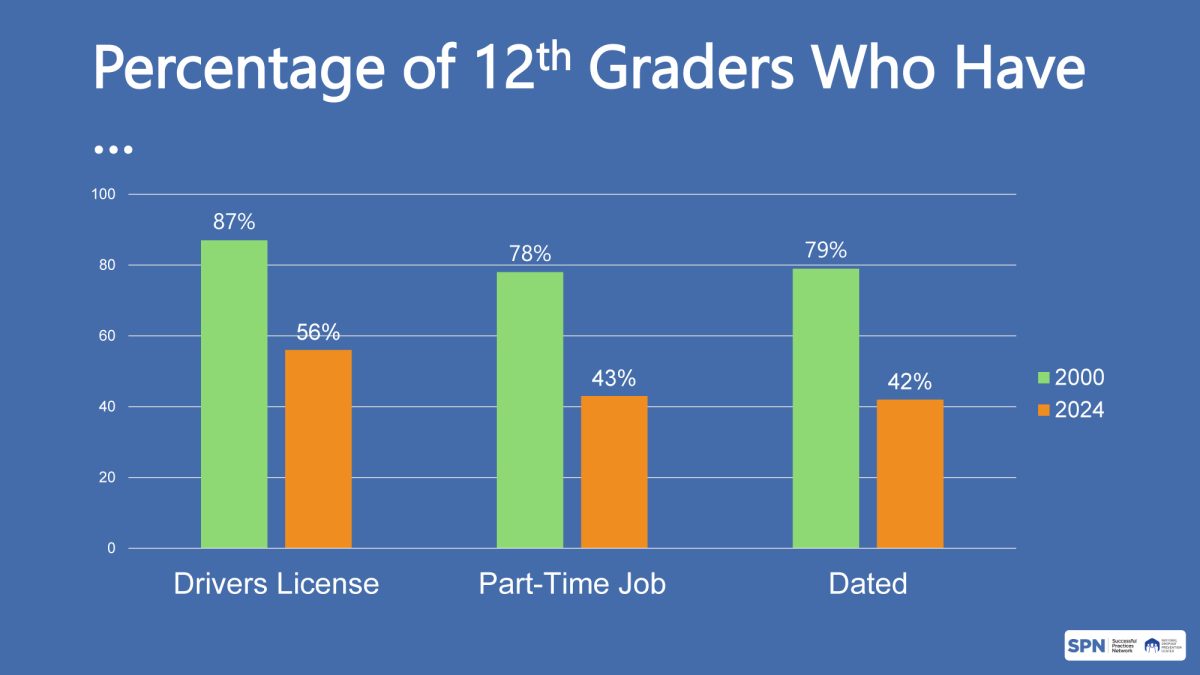
Successful Practices Network graphic.
“The most connected generation, technologically, has become the least connected generation, socially,” Daggett said.
The percentage of students starting postsecondary programs who earn a degree in six years is now only 43 percent. “If that was K-12 education, we would say they had a 57 percent dropout rate,” he noted.
The amount of students from the lowest income quartile who earn a bachelor’s degree in six years is 13 percent. This is the fastest growing group of students in the country.
Moreover, the amount of recent college grads who are underemployed or working jobs that do not require a college degree is 41 percent.
The number of people looking for work for every one job opening is 0.73 persons, as of February 2024, according to U.S. Chamber analysis of Bureau of Labor Statistics data. Back in 2004, it was about 2.5 persons per job opening, meaning employers had a selection of candidates.
“Who are employers hiring? People they never would have hired in the past,” Daggett explained.
Then there’s the Baby Boomer effect. In 1960, 39 percent of the population in this country was under age 19 and only 13 percent was over age 65. There were three young people entering the workforce for every one who retired. But Baby Boomers have begun to retire lately — at the same time the U.S. is experiencing a declining birth rate. By 2035, this is expected to flip, with only 23 percent under age 19 but 24 percent over the age of 65.
“That makes today’s labor shortage look like child’s play, and every employer has to do something different. That’s why they see AI as a solution, like it or not,” Daggett said.
North Carolina’s employers said their single biggest problem is lack of workforce. Other top challenges include chronic absenteeism, poor work ethic, and mental health problems.
This has led, in 2024, several top companies to eliminate or decrease emphasis on college degrees, including: IBM, GM, Bank of America, Google, Walmart, Apple, Nike, Delta Airlines, Amazon, Accenture, Target, Ernst & Young, Hilton, Starbucks, and Penguin Random House.
What has replaced college degrees at those companies are micro-credentials, such as AI prompt engineer (how to ask AI a question). Google, for example, has a $136,403 starting salary for prompt engineers and created a four-week training program for those jobs. Some 147,000 students have signed up for the training, said Daggett.
He said perhaps schools should discuss training students on writing AI prompts, even though the skill isn’t on state tests — because it wasn’t even needed 18 months ago.
“AI isn’t going to replace all jobs any more than automation replaced all the jobs on a farm. I grew up on a dairy farm in upper New York State. It just changed the farming industry…What’s about to happen is what automation did to manual workers in the 20th Century, AI is about to do to knowledge workers at an incredibly accelerated rate,” Daggett related.
Recent surveys of many employers, conducted by McKinsey and Company, showed literacy and math top of the wanted cognitive skills list. However, eight skills not on standardized tests were also important: creativity, adaptability, organization, problem-solving, prioritization, planning, critical thinking, and communication. (Those latter eight skills are the very ones today’s children have deficiences in, due to screen-based play.)
Children are seeing increased deficits in interpersonal skills, including: honesty, trust, teamwork, empathy, humility, collaboration, motivation, relationships, role modeling, and coaching.
Today’s youths also lack in self-leadership skills, such as: persistence, integrity, self-control, coping, risk-taking, resilience, self-motivation, self-confidence, passion, and being achievement-oriented.
“Ladies and gentlemen, we have got to prepare our kids for their future, not our past,” Daggett emphasized.
He shared three national studies with the group. One was on dropout prevention, noting there is a growing absentee problem in America’s schools. The second study was on best practices to make sure youths are gainfully employed six years after graduating high school. The third study, My Future North Carolina, created by the Governor and State House Speaker, looked at what to do to ensure an adequate workforce for the future.
From kindergarten through grade four, schools focus on reading, writing, and math. After grade four, Daggett noted, schools tend to focus on content, because that is what is testable in today’s environment.
He noted employers seek different skills than schools focus on. Schools tend to place importance on content, what kids know, testing individual work, predictable situations (having either a right or wrong answer), siloed disciplines, and see AI as a threat.
What students will need to be successful in the changing workplace are: skills, applying knowledge, working in teams, dealing with the unpredictable, having transferable disciplines, and seeing AI (Artificial Intelligence) as a solution.
“AI, whether we like it or not, is coming at us like a tidal wave,” Daggett said. “If you can write an algorithm, for any task, AI can do it faster, more efficiently, than any human being. Anything that is predictable, you can write an algorithm for it. So, what do our employers need? They need kids that can deal with the unpredictable, where they have to use problem solving skills and deeper decision skills, and creativity. They have a different set of skill requirements. But we have conditioned our kids to deal with everything that’s predictable. So, when they get out of that environment, it really throws them.
“The other difference is, we operate in silos,” Daggett said. He noted that children have separate class periods in middle and high school for different subjects. “Once you leave school, [a student] has to integrate all those subjects. The real world is interdiscinplinary. We’ve conditioned them to think everything functions in silos.”
“What’s accelerating this issue around the country is AI can help that integration, if they choose to,” he continued. “The problem is, AI is a real threat to our instructional practices.” He mentioned that some have used AI to cheat. “However, business and industry has a labor shortage. Employers are increasingly saying AI can help solve the problem and do some tasks that humans are paid to do. The world outside the school is increasingly seeing AI as a solution.”
Superintendent gives his view on topic
“Please note that, in order to do this work, it’s like turning the course of an aircraft carrier — you have to do it very, very slowly,” said Superintendent Griffin. “We know there has to be change. We know our students are coming to us differently. But in the classroom, we can’t just make that change overnight. But shame on us if we don’t at least start having that conversation.”
“This is not going to be interjected into our classrooms immediately, but these are things we see with our young people as they work through not only their educational careers, but their lives. We’re starting to look at trends for success,” said Dr. Griffin. “Some of the research that Dr. Daggett does, all over the world and in the United States, we’re tapping into, to say: What can we do that’s going to produce a great product for our children? When they graduate high school here in Alexander County, what can we do to help them be successful in life?”
About Dr. Daggett
Dr. Daggett is founder of the International Center for Leadership in Education. He is co-chair of Learning 2025: National Commission for Student-Centered Equity-Focused Education. An educator, he also served as a teacher, local administrator, and a director with the New York State Education Department. Daggett is noted worldwide for his ability to move education systems toward more rigorous and relevant skills and knowledge for all students. For more information on Dr. Daggett, visit spnetwork.org/elementor-1535/.