Former ACHS student enjoying NASA internship

By MICAH HENRY
With a mind for engineering, former Alexander Central High School student Luke Kiziah, 21, is going places. Currently, he is in Texas, taking part in a NASA internship with a private business in the aerospace field.
Luke is the son of Greg and Sonia Kiziah, of Wilmington, formerly of Taylorsville. He has a younger brother, Riley.
Luke’s goal is to pursue a career in the aerospace industry. After attending Alexander Central High School for three years, his family moved to Colorado for a year, where he graduated high school, then came back to North Carolina.
Luke began college at UNC Wilmington, intending to study coastal engineering. However, during his first semester, a project led him to shift his interest to either mechanical or aerospace engineering.
Between his first and second semester in college, he went on a trip to Cape Canaveral — for surfing — and while there, went on a tour of the Kennedy Space Center with his father.
Luke asked the staff at Kennedy what he needed to do to work at NASA. They told him to major in mechanical or aerospace engineering and look into NASA internships.
“I thought you couldn’t get a career in aerospace, because that’s too niche,” Luke said, so he aimed to major in mechanical engineering.
As UNC-W didn’t have a mechanical engineering program, Luke transferred to NC State University, where his studies include engineering, computer science, and physics.
Last summer, he interned at an aerospace company in Virginia.
This spring, he wrapped up a NASA internship in the area of Human Landing System and Guidance, Navigation, and Control at the Marshall Space Flight Center in Huntsville, Alabama. There, he worked to train computer neural networks to fly quadcopters (drones) in real-time, calculating trajectory with position, velocity, and
acceleration factors to use the least amount of battery power required.
“An artificial neural network is similar to a brain,” Luke explained. “There are many sensor inputs that propagate through artificial neurons, similar to how synapses transmit information from the five senses to neurons in the brain.”
He said the networks are small enough to run on systems built into the drones, with hardware running calculations about 100 times per second.
Now, as a rising senior, Luke is in Houston, Texas, taking part in a 10-week NASA-based internship at Intuitive Machines, a NASA contractor, through the Johnson Space Center.
“I’m loving my current internship,” said Luke.
At Intuitive Machines, Luke is working on the propulsion side of things, as well as on a software controller for throttle on a rocket engine, for precision burns. He will wrap up the internship in early August.
He contrasted the Alabama internship at NASA with the current one at the private company.
“At NASA, you’re usually very focused on one specific thing. Here, you wear a lot of hats: inspection, assembly, testing, modeling. You get hands-on as well as computer work.”
In addition to his studies, Luke excelled in cross country at ACHS in his sophomore and junior years. He was also Studio3 concertmaster violinist and plays guitar, banjo, mandolin, and fiddle, having taken part in his early years in the Junior Appalachian Musicians (JAM) meetings held in Hiddenite.
Luke hopes other high school or college students will be inspired to look at the potential careers in the aerospace industry through NASA internships. For more information, visit online, intern.nasa.gov.
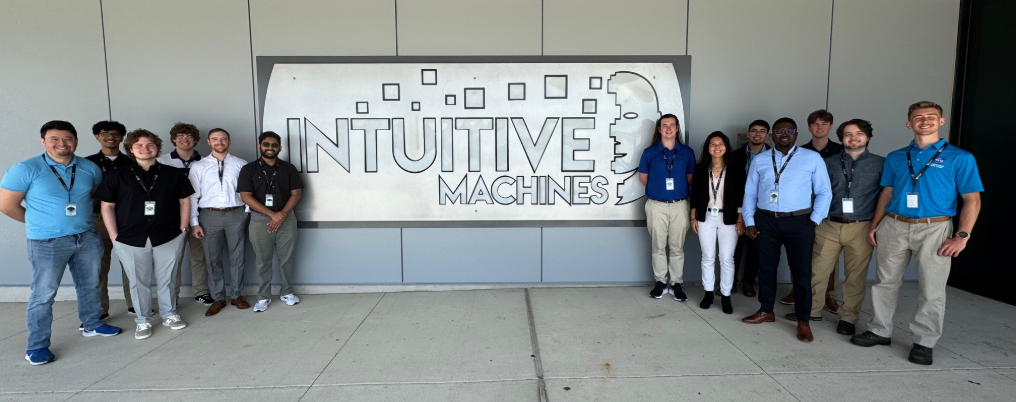
Luke Kiziah (at far right) is shown above during his internship at Intuitive Machines in Texas.

NASA INTERN — Former Alexander Central High School student Luke Kiziah, 21, is taking part in NASA internships this summer after completing an earlier one in the spring. Pictured above, left to right, at Marshall Space Flight Center (MSFC) in Huntsville, Alabama: Michaela Tarpley (EV42 GNC Engineer), Matt Hawkins (EV41 GNC Engineer), mentor Chris Proctor (EV42 GNC Engineer), Juan Orphee (EV42 GNC Lead), Luke Kiziah, and Mark Jackson (EV41 Branch Chief). EV42 is the Guidance, Navigation, and Mission Analysis branch and EV41 is Control Systems Design and Analysis branch. “It was at the end of my last day at NASA MSFC at our quadcopter lab at the University of Huntsville, just after flight tests using the neural network I trained. In this case, it acted as an optimal controller for trajectory tracking (an originally unplanned capability) that ran in real time on the drone while we gave it trajectories to follow,” Kiziah explained.