Local business warns others to be wary of check fraud
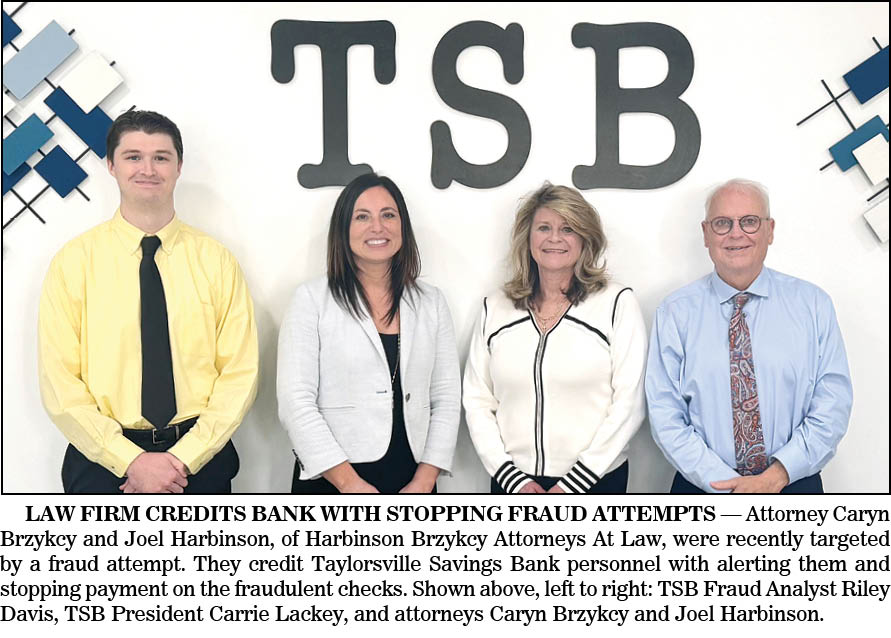
Local residents and business owners are urged to be vigilant of check fraud, following one recent example which was preempted, thanks to the work of keen bankers.
Attorney Caryn Brzykcy, of Harbinson Brzykcy Attorneys At Law in Taylorsville, explained that a $32,000 fraud was attempted against their firm’s checking account recently.
“We had no problem for 30 years, then there were six attempts in a week,” Brzykcy related.
The attempts were what is known as “check washing.” The U.S. Postal Inspection Service explains that check washing scams involve changing the payee names and often the dollar amounts on checks and fraudulently depositing them.
Brzykcy said that the firm’s bank, Taylorsville Savings Bank, had detected the fraudulent deposits and alerted the firm.
Carrie Lackey, President of Taylorsville Savings Bank, explained that most large banks put the burden on business customers for fraud prevention in a system known as Positive Pay. In Positive Pay, the account holder must approve each check as it is deposited. This proves expensive for a small business and doesn’t put any burden on the bank at all.
However, Taylorsville Savings Bank recently implemented a system about a year ago that allows them to stop fraudulent checks. The program compares checks being deposited to valid checks, making sure the check isn’t for an abnormally large amount, isn’t numbered out of sequence, isn’t a repeated check number, has proper known signatures, and other items.
The bank also created a new position, that of Fraud Analyst, to combat check fraud.
Lackey said the new system allows TSB to stop from 90 to 95 percent of check fraud now but notes that it would be hard to stop 100 percent of fraud.
Checks are typically processed in this manner: a check is presented to the First Bank Of Deposit (FBOD), when a check clears this bank, this bank gives the fraudster the money, then the FBOD sends the check to the account holder’s bank for collection. If the account holder’s bank detects fraud and issues Stop Payment, this must be done in the 24-48 hour window. Because of the small time window to return a check, the new system at Taylorsville Savings Bank has been instrumental in helping detect fraud and protect customers.
Another method through which fraud can be prevented is through ACH, or Automated Clearing House, payments from bank accounts. ACH payments allow up to 45 days for payments to be processed, giving ample time for investigation. Thus, some banking customers are switching their checking accounts to ACH payments.
Lackey, who serves on multiple banking industry boards, says bankers are trying to get legislation passed to give banks more time to investigate checks and better prevent fraud.
More tips from bankers
Another local bank, First Community Bank, makes use of advanced check-fraud detection technology designed to identify suspicious items quickly. Their system analyzes deposited checks against account history and expected check activity, helping flag warning signs such as altered payees or amounts, duplicate or out-of-sequence check numbers, unusual dollar amounts, and other indicators that a check may have been washed or otherwise manipulated.
While no fraud-prevention tool can stop every attempt, this type of automated review gives the bank another important layer of protection and helps reduce losses for customers when criminals target business or consumer checking accounts.
Kendra W. Dyson, Branch Leader at First Community Bank in Taylorsville, shared several tips to fight fraud, listed below.
Tips to Stay Safe While Traveling
• Notify your bank before you travel.
• Enable account alerts for transactions
• Use strong passwords and multi-factor authentication
• Carry only what you need—leave extra cards at home
• Regularly review your account activity
If Something Doesn’t Feel Right…
• Contact your bank immediately using the number on your card
• Freeze your card if suspicious activity occurs
• Report fraud as soon as possible
Wire Fraud: Don’t Send Money Blindly
Fraudsters are tricking customers into sending wires by posing as trusted sources:
• “Updated” wiring instructions for real estate deals
• Changes to vendor or business payments
• Urgent requests from a known contact
• “Too good to miss” investment opportunities
• Unexpected requests from friends or family
Pause if:
• Instructions came via email or text
• Payment details suddenly changed
• You feel rushed or pressured
• This is your first time sending a wire
Phone Call – Text Approval Scam
How it works:
• Scammer calls pretending to be the bank
• Claims there’s fraud on your account
• Tells you to reply to a text to “stop” it
• The truth: That text is a real bank alert-and replying can approve the fraud.
• When in doubt, pause the transaction and escalate according to fraud procedures.
Red Flags
• “The bank just called me….
• Told to respond to a text message
• Belief that replying will “stop fraud”
• Pressure to act immediately
• Unusual or out-of-pattern transactions
Stop. Verify. Protect.
• Stop – Don’t act on urgency.
• Verify – Hang up and call a trusted number.
• Protect – Never approve transactions based on incoming calls
Remember, your bank will never call and ask you to approve a transaction by text.
• Do not trust incoming calls-call the number on your card.
• Responding to a text can authorize a transaction.
Common Travel Scams to Watch For
• Fake Booking Websites: Fraudsters create lookalike hotel or rental sites to steal your money and personal info. Book only through trusted websites or directly with the hotel.
• Phishing Confirmations: Fake emails or texts may look like booking confirmations or flight changes. Don’t click links—log in directly to your account to verify.
• Public Wi-Fi Risks: Hackers can steal your information on unsecured networks. Avoid accessing banking apps or entering passwords on public Wi-Fi.
• Card Skimming & Theft: Tourist areas are common targets for card fraud. Use tap-to-pay when possible and monitor transactions daily.
U.S. Postal Service tips
The U.S. Postal Service suggests the following ways to prevent mail fraud involving checks:
• Deposit mail before the last pickup at a mailing location, give your outgoing mail to your letter carrier, or take it to your nearest Post Office.
• Retrieve your mail frequently. Never leave mail in your mailbox overnight.
• If you’re going on vacation, have your mail held at your Post Office or have it picked up by a friend or neighbor.
• When writing checks, use a gel pen. They have ink characteristics that are difficult to remove from checks.