Scott keynotes MLK Ceremony
By MICAH HENRY
Eric Todd Scott, President of the NAACP Statesville Branch since April 2019, served as keynote speaker at the Alexander County NAACP’s Annual Dr. Martin Luther King, Jr. Celebration on Monday, January 20. The event took place at Macedonia Baptist Church on NC Hwy. 90 East in Taylorsville.
Alexander NAACP Vice President Helen Chestnut served as Mistress of Ceremonies. Rev. William Little, pastor of Smith Grove Baptist Church in Hiddenite, read from Psalms 46:1-6. Macedonia’s pastor, Rev. Ty Michaux, offered the opening prayer and welcomed the audience.
Ms. Chestnut brought an appeal to the audience to join or renew NAACP membership.
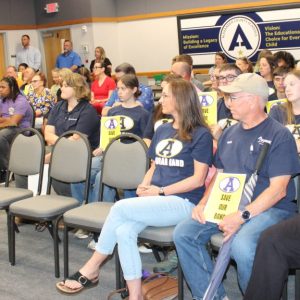
Local elected officials brought greetings, including Taylorsville Mayor George Holleman, Police Chief Mike Millsaps, Alexander County Sheriff Chad Pennell, and Alexander County Clerk of Court Edwin Chapman. Chapman noted that County Commissioner Larry Yoder was unable to attend due to work. Holleman urged people to read King’s “Letter from the Birmingham Jail,” sent to all the pastors in that city while he was in jail.
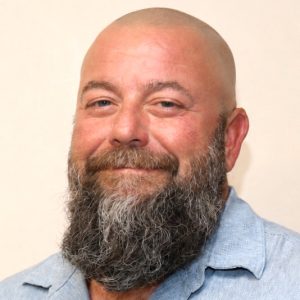
Police Chief Mike Millsaps, the first African-American to head the police force for the town, gave honor to the Lord for allowing him to serve the community. He also said that as important as it is in celebrating the life of Dr. King, it is also important to celebrate the community, who “kept on rolling” after King’s death. “It’s a community that can be what you make it. It starts in the mirror. If you get up every morning and you see doubt in this person and that person, don’t worry about those people. Worry about that person you’re looking at in the mirror. If you say you’re depressed and all these things are happening, and you can’t change them — change that person in the mirror first. Then the rest of it will fall in place because God’s always working.”
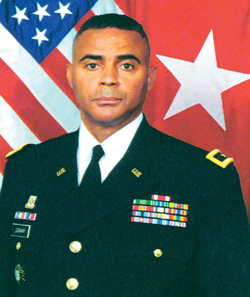
Sheriff Pennell thanked the Lord also. Pennell noted King’s example, respect for one another, love one another. Pennell left the audience with the question: “What are you teaching the next generation? I think that is more important than anything else. It’s our responsibility, as this generation, to teach the next how we can love one another, take care of one another, how we respect one another.”
Chapman thanked the Lord for His blessings and the many friendships in the community. He recalled a quote he recently found from an English paper he did on Martin Luther King, Jr. in high school. King said, “I have decided to stick with love. Hate is too great a burden to bear.”
Alexander NAACP President Rev. Sterling Howard introduced the guest speaker.
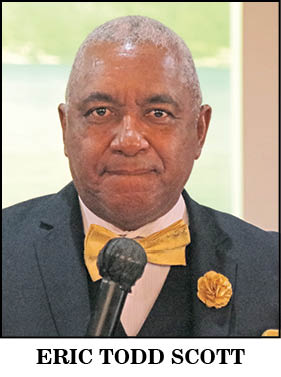
Scott urged local leaders and youth to join the NAACP. His topic was “Martin Luther King, Jr. Did Not Die In Vain.”
Mr. Scott read an excerpt of “Letter From a Birmingham Jail” which King wrote. “People were trying to bomb his house, kill his family. Think about that. Take yourself back to that time. There were dogs, police dogs, in the street. People were arrested for anything,” Scott said.
The letter was a public response to a statement of caution and concern issued by eight white religious leaders of the South regarding the non-violent protests of segregation.
King wrote: “I think I should give my reason for being in Birmingham since you have been influenced by the argument of outsiders coming in. I have the honor of serving as President of the Southern Christian Leadership Conference, an organization operating in every Southern state, with headquarters in Atlanta, Georgia. We have some 85 affiliate organizations all across the South, one being the Alabama Christian Movement of Human Rights. Whenever necessary and possible, we share a staff and are on call to engage in non-violent, direct-action programs, if such were deemed necessary. We readily consented and, when the hour came, we lived up to our promises. So I am here, along with several members of my staff, because we were invited here. I am here because I have basic organizational ties here. Beyond this, I am in Birmingham because injustice is here, just as the prophets of the eighth century B.C. left their little villages and carried their, ‘Thus saith the Lord’ far beyond the boundaries of their hometowns. And just as Apostle Paul left his little village of Tarsus and carried the Gospel of Jesus Christ to practically every hamlet and city of the Greco-Roman world, I, too, am compelled to carry the gospel of freedom beyond my particular hometown. Like Paul, I must constantly respond to the Macedonia call for aid. Moreover, I am cognizant of the interrelatedness of all communities and states. I cannot sit idly by in Atlanta and not be concerned about what happens in Birmingham. Injustice anywhere is a threat to justice everywhere.
“We are caught in an inescapable network of mutuality, tied in a single garment of destiny. Whatever affects one directly affects all indirectly. Never again can we afford to live with the narrow, provincial, and ‘outside agitator’ idea. Anyone who lives inside the United States can never be considered an outsider.
“I would not hesitate to say it is unfortunate that so-called demonstrators are taking place in Birmingham at this time. I would say, in more emphatic terms, that it is even more unfortunate that the white power structure of this city left the Negro community with no other alternative. In any non-violent campaign, there are four basic steps: collection of the facts to determine whether injustices exist; negotiation; self-purification; and direct action. We have gone through all of these steps in Birmingham. There can be no gainsaying of the fact that racial injustice engulfs this community. Birmingham is probably the most thoroughly segregated city in the United States. It’s ugly record of police brutality is known in every section of this country. It’s unjust treatment of Negroes in the courts is a notorious reality. There have been more unsolved bombings of Negro churches and homes in Birmingham than in any other city in this nation. These are the hard, brutal facts of the case. On the basis of these conditions, Negro leaders sought to negotiate with the city fathers. But the latter consistently refused to engage in good faith negotiation.
“Then, last September, came the opportunity to talk with leaders of Birmingham’s economic community…As in so many past experiences, our hopes had been blasted, and the shadow of deep disappointment settled upon us. We had no alternative except to prepare for direct action, whereby we would present our very bodies as a means of laying our case before the conscience of the local and the national community.”
Scott noted that King was killed in 1968. King’s mother, Alberta Williams, was shot and killed while playing organ at Ebenezer Baptist Church in 1974, at the hand of a 23 year old Marcus Wayne Chenault, a Black man from Ohio. Chenault also killed Deacon Edward Boykin and wounded another church member as well. Chenault stated that “All Christians were his enemies.”
Mr. Scott recalled that, during his middle school days, he saw the KKK surround his ballfield in their sheets and his coach had to distribute baseball bats to the players. He and his team were also the subject of racial slurs shouted at a school basketball game in 1978 in which the crowd, including a Sheriff’s deputy, shouted “monkeys” and the N-word at them.
“This influenced my life and career,” Scott said. “I’ve always spoken out when people were scared to, like Martin Luther King, Jr.”
“We to stop hating people because of the way they vote,” Scott continued.
“1 John 4:20 says, ‘If a man say, I love God, and hateth his brother, he is a liar: for he that loveth not his brother whom he hath seen, how can he love God whom he hath not seen?’”
He noted that the MLK Day is the only Federal holiday that is designed as a day of service, to encourage all Americans to volunteer and improve their communities.