Father, son find over 260 Native American artifacts

By MICAH HENRY
“Like father, like son” — that saying holds true for Alan Bentley, 67, and his son, Travis, 44, of the Sugar Loaf Community. Both are avid relic hunters, and their attention to the observing the ground around them has netted many interesting local discoveries.
Alan recalls that, as a boy, he found his first artifact, an arrowhead, below the family barn on an old motorcycle trail. That sparked an interest that is still with him, going on 60 years later.
“We farmed and Dad tended tobacco fields,” Alan said. “Tobacco fields were the best hunting, the way they ridge everything up and rain washes the soil down and exposes things.”
There was no shortage of places to “hunt,” in Alan’s younger days. Folks were usually agreeable to let Alan and a few family members or friends roam their fresh-tilled gardens or fields, before planting.
He said one man he approached about hunting for points on the man’s property said, “That garden is 150 years old. If anything was there, we’d have found it by now. But go ahead.” Alan ended up finding a piece of clay pipe!
After Travis was born and old enough to join his dad on “hunting” trips, Alan and Travis really bonded over the common love for finding these long-lost artifacts, hidden beneath the soil for centuries.
“It’s a rush — that thrill of seeing it” in the soil, Alan explained.
Nowadays, Alan’s son-in-law, Justin Cremeans, joins Alan and Travis, too.
In late 2021, they received permission to look over some land near NC 16 in Taylorsville (Alan asked The Times to keep the exact location vague to foil any uninvited hunters). After some scouting, they identified a likely rise which they hoped could be a cache. That is the term for a number of points deposited in one spot, to keep them from being stolen or to avoid having to carry them on trips, if the tribe would be returning to the area.
Scratching around in that location brought an exciting find — clusters and clumps of points! They began finding so many, they made several trips back to the spot in the coming weeks, often finding thirty or forty each trip. Their initial find in October 2021 led to repeated excursions there, up through February 2022.
They built screens to sift the items from the soil and rinse them off.
In all, Alan counted about 265 points or blades found in the single area. The artifacts are all made from rhyolite. One point and a flint they found were a green rhyolite.
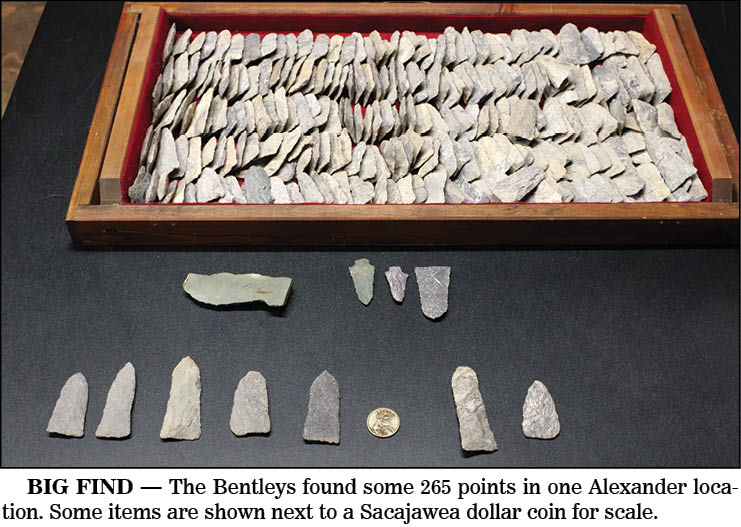
Rhyolite is an igneous rock, according to the Mineralogical Society of America. It is formed from the rapid cooling of a magma or lava that contains a lot of silica (quartz). MSA describes rhyolite as usually light colored: light gray, tan, reddish, greenish, or brown. It is fine grained, but often contains scattered larger crystals.
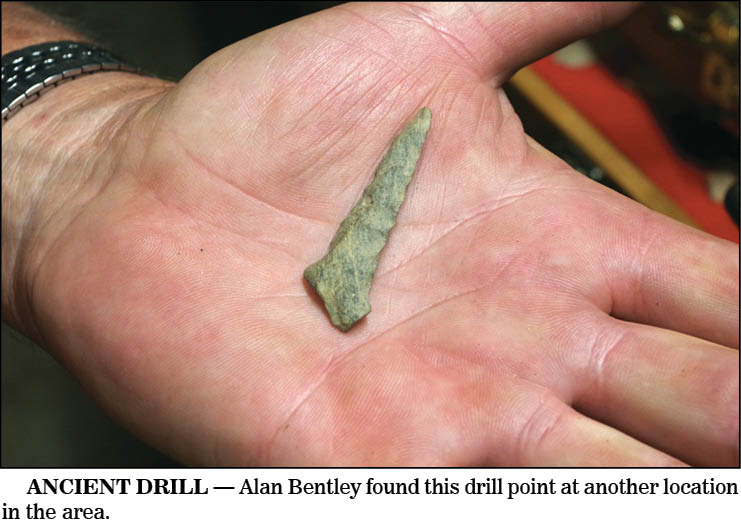
Through the years, Alan has found blades like those along NC 16 but also arrowheads, fragments, pottery, drill points, and atlatl (spear) points. These are larger points, launched on the tip of a stick, which are quite deadly, predating the bow and arrow.
It is interesting to imagine the time and skill involved as the Native Americans found the rock, expertly chipped and sharpened the points, waiting to be used to sustain their lives on this rugged land.
For Alan and Travis, they look forward to finding more of these treasures lurking beneath the surface.