Veterans’ Day ceremony held Nov. 11
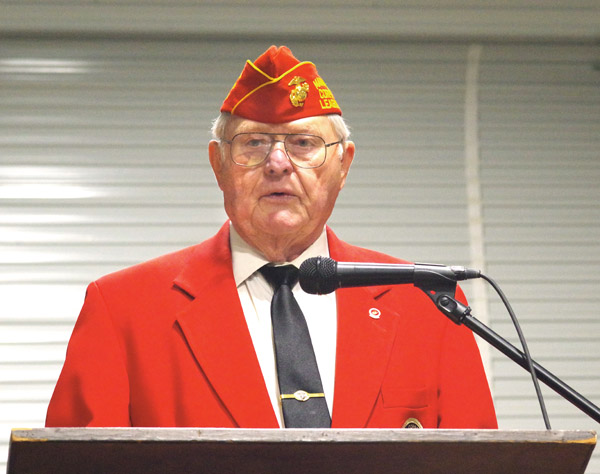
GUEST SPEAKER — Master Gunnery Sgt. John U. Irwin, USMC Retired, of Sparta, was guest speaker at the Alexander County Veterans’ Day Ceremony held on Tuesday, Nov. 11.
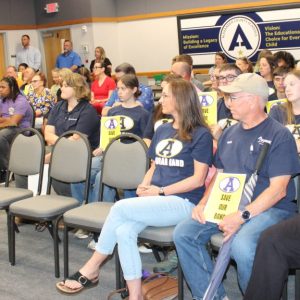
A number of local veterans and their families gathered on the blustery, cold morning of Tuesday, Nov. 11, 2025, at the Disabled American Veterans – VETCOM (Veterans’ Committee) building on Carrigan Road in Taylorsville.
This event marked the observance of Veterans’ Day in Taylorsville. Cadets with the Alexander Central Navy Junior Reserve Officer Training Corps (NJROTC) presented the colors to begin the ceremony. Veterans of Foreign Wars Post 5466 Chaplain Gary Sprinkle gave the invocation.
Guest speaker, Master Gunnery Sgt. John U. Irwin, USMC Retired, of Sparta, was introduced by DAV Chapter 84 Commander Bill Johnson.
Irwin noted that today, less than six percent of the population of the United States have ever served in the Armed Forces. In all, 41.6 million men and women have worn the uniforms of military service. Sadly, some 35 percent of today’s youth are ineligible to serve, either by being physically or mentally unfit, having a police record, or a history of drug use.
“I’m not bad mouthing the younger generation,” Irwin said. “I was privileged to serve my five last working years training young Marines in the new communications equipment that was being issued prior to the wars in Iraq and Afghanistan. They are the pride of this nation. They are the best of what we have.”
“Whenever I went through boot camp, we didn’t have the Crucible. Now, they have the Crucibile. Whenever I go down to Parris Island, I look at those young men and women, it is unbelieveable what they are doing.”
Irwin said he feels this nation is at a precipice. “Who would have ever thought, when we put on the uniform, my fellow veterans, one day that we would elect in the largest city in the nation, an avowed communist? [New York City] We wore the uniform to prevent Communism, we thought. We don’t teach history, ladies and gentlemen. They do not know, the young people that come out into the world do not realize because we do not teach them about the sacrifices that went on in World War I, World War II, Korea, and Vietnam, by those of us that served.”
Irwin said that youth of today may look at Vietnam-era vets and see gray hair, pot bellies, or their difficulty moving around.
“We won every battle we fought. But the politicians lost the war,” Irwin related. “At the end of Vietnam, politicians pulled the money from South Vietnam, reduced it to $700 million a year. South Vietnamese had to ration artillery. The sacrifices we had made went down the drain. With it, Vietnam veterans came home met with derision, spat upon, and became pariahs in the public.”
He related a story about one Vietnam War veteran, Sgt. Maj. Bill Franks, who arrived back in the States from the war. At the Chicago airport, he and other military members noticed flag-draped coffins coming off the airplane, so Franks and others saluted the coffins. He felt something hit him. After the coffins had passed, Franks looked around to find someone had tossed a bag full of dog feces at him.
Even though Franks had never drank before, he was so troubled by the thoughtless action that he went out to a bar and began drinking. When Franks met Irwin, Franks was a Sgt. Major by day but “a drunk” at night, Irwin said. However, in the Persian Gulf War, when the parade went through Washington, D.C., Franks watched it on TV and was encouraged to clean up his life. He never drank after that.
“Then, he felt he was respected as a veteran,” Irwin said, of Franks.
“Everything that I accomplished in life, I owe to what I learned in the Marine Corps. To me, I was not a leader, but the Marine Corps saw something in me and said, ‘You will be,’ and forced me and pushed me. It builds you. Whenever you come out, that mettle that has been formed continues, for until the day you die, you will be a veteran, proud of your service.”
“You look at these old men in this room, but you don’t know what it’s like for them to go out on a flight line that’s 130°F at work, day in and day out, Sundays don’t mean anything, just to keep those aircraft flying, whether they’re Army, Air Force, or Marine Corps. You don’t know what it’s like to sit in a hole, freezing, in Korea, like our brethren in the Army on the DMZ in Korea as we speak, -35°F and wind blowing. You freeze. You don’t know what it’s like to share a C-Rat[ion] or an MRE with a fellow soldier in that hole with you.
“You will hopefully, God, I pray, not know what it’s like to have to have an armed escort to go perform bodily functions, because whenever you drop your trousers, you can’t run and you can’t grab that rifle too daggone quick.”
“You don’t know what it’s like to go days without sleep, without food. You do not know the sacrifices that have been made for this country by the men and women that have worn that uniform. It is a lonely business. It is a dangerous business.”
Irwin said remembering the major peacetime exercises that he went on, he could not recall one without a death or serious injury. War, of course, is another matter.
Irwin’s grandfather spent most of his time in World War I in the trenches in Europe. He told the young Irwin that while they were in the trenches, they didn’t recover the dead.
Irwin said that today, Flanders Fields in Belgium and France are one-third soil, one-third metal, and one-third human remains from all the death and destruction there during World War I.
World War II, Korea, Vietnam, and newer era war veterans have similar haunting memories and stories, he said. Those who make it home from service deserve respect.
“Every veteran you see has given up a portion of his life in service to this country,” Irwin said. “Please remember that.”
He urged the audience to greet veterans, to listen to their stories, and thank them for their service.

CADETS PARTICIPATE — Cadets with the Alexander Central Navy Junior ROTC presented the colors at the Veterans’ Day ceremony on Tuesday.
About John Irwin’s life and career
Irwin served in the U.S. Marine Corps during December 17, 1967-May 7, 1971 (Inactive Reserves), May 7, 1971-July 7, 1974, (Regular), August 7, 1974-February 26, 1975, (Active Reserves), and February 26, 1975-July 7, 1993 (Regular).
He entered the Marine Corps Platoon Leaders Class (PLC) program on Dec 17, 1967, and enlisted May 7, 1971, on a three-year tour. During his initial tour of duty, with 1st Battalion, 10th Marines, he deployed on the first NATO cruise to Norway, as a Field Radio Operator/ Naval Gunfire Spotter and numerous Caribbean Cruises. He was released from active duty on July 7, 1974, with the rank of Sgt.
Irwin then enlisted in the active reserves, Communications Company, H&HS 4th Marine Division, and was promoted to SSgt. (Staff Sergeant). Due to the pending collapse of the Republic of Viet Nam, he was offered the opportunity to re-enlist with the loss of a stripe and immediate orders to 3rd Marine Division, Okinawa. He participated in the evacuation of Viet Nam, Operation Frequent Wind, receiving a Certificate of Commendation and Combat Action ribbon. Upon completion of his overseas tour, Irwin was transferred to Drill Instructor School, Parris Island, SC.
Upon completion of DI School, he was assigned to F Company, 2nd Recruit Training Battalion (RTB) for service as a Drill Instructor for four platoons and Senior Drill Instructor for two, in 18 months. He served as Standard Operating Procedure (SOP) instructor for nine classes at Drill Instructor School for the remaining 18 months of a three-year tour. Irwin was promoted to GySgt meritoriously and awarded a Certificate of Commendation.
Irwin was medically retired on July 7, 1993, with 21 years and seven months of active service, as a Master Gunnery Sgt.
His Military Occupational Specialties included Communications Chief, Frequency Manager, Artillery/Naval Gunfire Spotter, Drill Instructor, Primary Marksmanship Instructor, and Basic Parachutist.
In his biographical notes supplied to VFW Commander Bill Johnson, Irwin noted that his most memorable experience in service was being one of six Marines selected to participate as a member of the Directing Staff for Operation Raleigh. Operation Raleigh was a four-year series of expeditions to 32 countries sponsored by His Royal Highness, the Prince of Wales, Prince Charles. Irwin was director of a patrol comprised of twenty-two Ventures, ages 17-22, on a three-month patrol in the Andes of Chile. He received a personal Letter of Appreciation from the Secretary of Defense, The Honorable Casper Weinberger.
Irwin received the following recognitions: Meritorious Service Medal, Combat Action Ribbon, Naval Unit Commendation (two Bronze Stars), Meritorious Unit Commendation, Good Conduct Medal (Silver and Bronze Star), 7th award, Southwest Asian Service Medal (two Bronze Stars), Korean Defense Service Medal, Viet Nam Service Medal, Vietnamese Cross of Gallantry with Palm, Vietnamese Civic Action Medal 2nd Class, Kuwait Defense Medal, Saudi Arabian Service Medal, National Defense Medal with star, Sea Service Deployment Ribbon (two Bronze Stars), Drill Instructor ribbon, Basic Parachutist Badge, Rifle Expert Badge (4th Award), Pistol Expert Badge (4th Award), Certificate of Commendation (3), Meritorious Mast (2), and Letters of Appreciation (4).
Post service, Irwin worked as a Government contractor, training Marines on the new communications equipment being issued prior to their deployment to Iraq and Afghanistan, 2006-2011.
The Governor of North Carolina presented him with the Volunteer Service Award in 2014.
Irwin also advised the Kenyan Wildlife Service in 2015.
He was elected to the Alleghany County Board of Commissioners and served 2016-2024.