
Fox is president of National Sorghum group, NSSPPA

Bradley Fox
By MICAH HENRY
Taylorsville resident Bradley Fox, 56, is currently serving as the President of the National Sweet Sorghum Producers and Processors Association (NSSPPA). Bradley, a native of Alexander County, has from his teens been active in sorghum cane growing and processing.
What is sorghum used for? It’s a cousin to sugar cane, but unlike sugar cane grown in tropical regions, sorghum can grow in the climate of this area. Similar to sugar cane, syrup derived from the crushed cane is boiled down and used as a sweetener.
A significant difference between sugar cane and sorghum cane is how they grow. Sugar cane grows from a rhizome and comes back every year after it is harvested. Sorghum cane is planted new each year.
Bradley points out that true molasses is a by-product of the sugar cane industry. It is different from sorghum syrup, which is commonly called “molasses” in this region.
Before the advent of processed sugar, in this area there were two natural sweeteners: sweet sorghum and honey. Neither require refrigeration.
Bradley recalls getting to see the sorghum syrup process as a young boy at a neighbor’s farm.
“Dad took us to watch as kids, over at Glade Fox’s on Liledoun Road,” Bradley said. Glade and his family are distant relatives to Bradley’s folks.
Glade Fox’s family had a “molasses” making setup with a wood-fired boiler pan in a covered shed, across the road from the family home.
A good friend, the late Dale Reese, and the Reese family raised sorghum and made “molasses,” and Bradley began helping Dale plant, cultivate, harvest, “squeeze,” and cook (boil down the raw juice into syrup) each year.
After a while, Bradley had the opportunity to raise a crop of sorghum cane all his own — it was his turn to call the shots. You could call it a rite of passage in the sorghum community. It is different “when it’s your decision, when to cut, squeeze, how long to cook. It turned out OK, but I feel like we’ve come a long way since then,” he said.
Bradley has had several of his own crops since that first one, and has learned more about sorghum each year.
More recently, he began helping the Clyde Herman family in Ellendale grow sorghum and process the cane, beginning in 2014. (The family had made “molasses” in the past, up until 1989, when Hurricane Hugo blew down the crop.)
How is molasses made?
The process of getting “molasses” from the field starts with the choice of which sorghum cane to plant. Bradley noted that he likes the variety called “Honeydrip” the best. It has a good, sweet, smooth taste with no strong aftertaste. Other popular varieties are M81E, KY1810, and Dale.
Then one needs to decide how much to plant. Bradley said a “run” (batch) of syrup can be produced from as little as 1/4 acre of sorghum. Some folks grow more, depending on how much “molasses” they want to make.
After the planting comes the cultivation. It takes from 90 to 150 days for the sorghum to mature, depending on the variety grown.
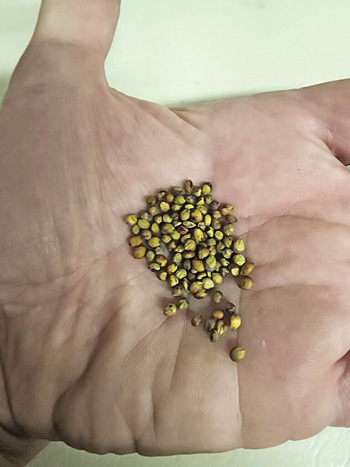
Sorghum seeds are rather small but grow to become tall plants.
Although some choose not to, Bradley prefers to “de-head” the sorghum near maturity, about a month before it is harvested. A tall cutting machine, known as a “de-header,” is driven through the field which cuts the seed heads off the tops of the sorghum stalks. It is done to improve the taste of the cane, reduce debris that needs to filtered from the juice, and make the stalks lighter and easier to handle. “The plant puts more energy into the sugar, once the seed heads are removed,” Bradley related.
Then, the stalks are cut off at the base in the harvesting process. They can lay a few days on a trailer but preferably are moved to the syrup mill to be “squeezed” (to extract the watery juice), within two weeks of harvest.
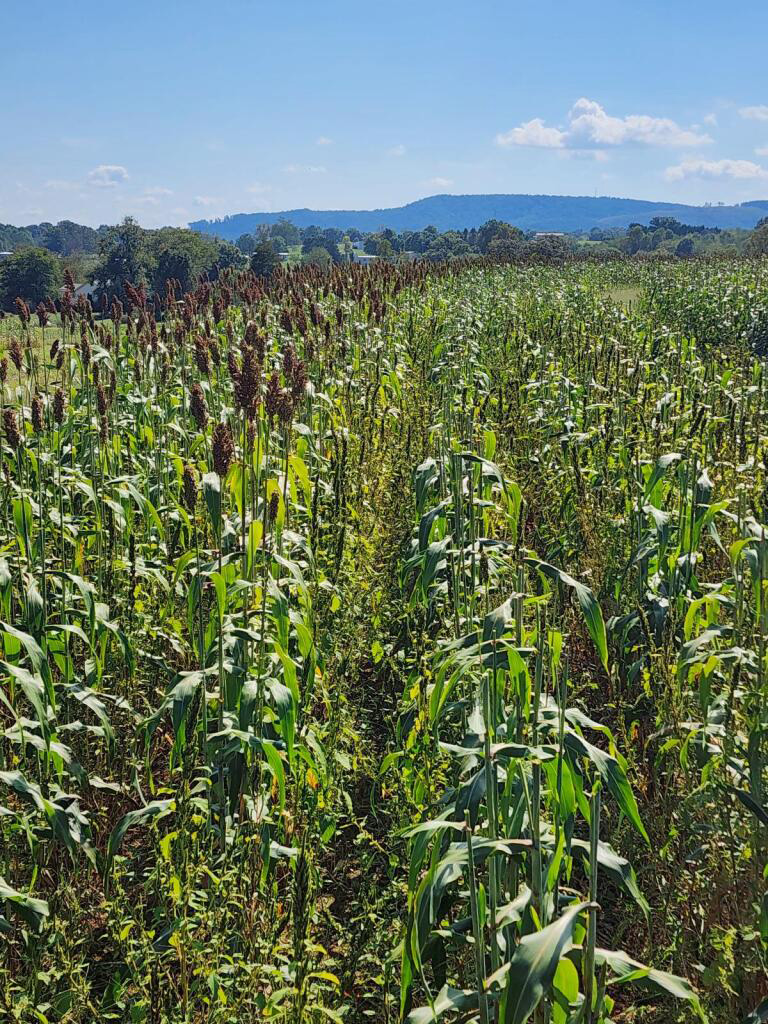
Sorghum is shown here near maturity.
Stalks are often transported to the mill on a flatbed trailer, due to their length.
The mills — some of which are quite old, including the mill used by Bradley — can be powered in a variety of methods. Those include mule or horse driven yoke, electric motor, gas motor, or tractor PTO.

PERENNIAL VOLUNTEERS — Above, left to right: Bradley Fox’s friends, Zayne Price and Faye Gentry, work to feed sorghum cane into a century-old Goldens cane mill, which squeezes the sweet juice from the stalks. Price, Gentry, and others volunteer year after year to help Fox and local growers process sorghum. After the cane is “squeezed,” the juice is collected and then pumped into a holding container to settle, before it is boiled down to syrup in a large pan over a fire.
The juice is collected from the crushed cane at the mill and filtered, then transferred to a large pan, vat, or kettle, where it is boiled until the excess water evaporates, leaving a thick syrup with high sugar content.
Bradley likes to add a step before boiling. This involves putting the juice into a settling tank, allowing starches to sink to the bottom. If syrup is put straight from the mill into the boiling pan, starches sink to the bottom and scorch, tainting the flavor. At the Herman farm, there is a settling tank and a preheater tank, too. Typically, two runs are made, one is settled before boiling and one is settled and preheated before boiling.
As the boiling is done, a pan-shaped tool called a skimmer helps remove debris and foam which floats to the surface. At the Herman farm, this is done in a rectangular, stainless steel pan which is heated over a wood fire. In other operations, a continuous flow evaporator is used, which boils syrup as it is channeled through baffles across a heated, shallow pan. The hot sorghum syrup (about 230°F) is poured into a cooling kettle and then decanted into bottles or jars.
During a two-batch run at the Herman farm, after the pan is emptied of finished syrup, a crew bottles the syrup from the cooling kettle while another crew washes the boiler, puts some fresh juice in it, sets it back on the fire, and finishes filling it up for the second run.
Bradley said it takes about 100 gallons of sorghum juice to make about 15 gallons of syrup.
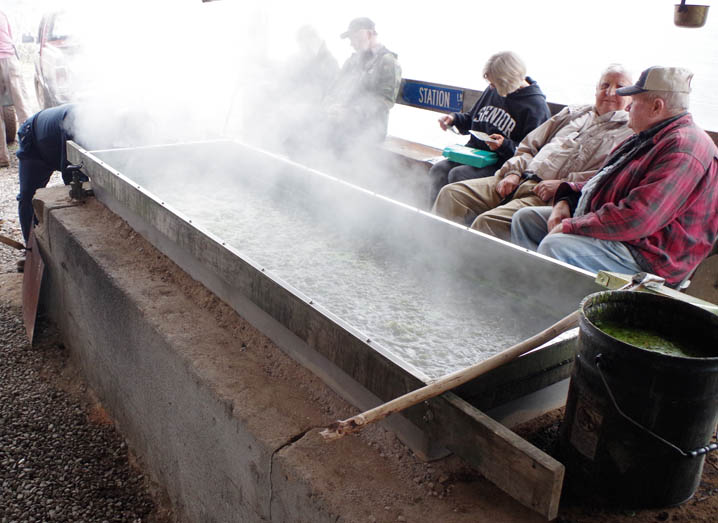
Sorghum is boiled down to syrup consistency in a large pan, seen here heated over a wood fire at the Herman farm.
There are several ways to determine when the syrup is sufficiently boiled down. Traditional methods involve seeing how the syrup drops form and fall from the skimmer, with thicker syrup forming longer drops. Bradley noted that if the drops elongate about an inch from the skimmer before dropping off, it’s time to pull the pan off the fire. Yet another way is to draw a spoon through a pan of cooled syrup and see how soon the syrup closes back together.
A more scientific method is to measure the sugar content of room temperature syrup. This is done with a refractometer, which gives a readout in Brix units. The U.S. Department of Agriculture considers syrup as 74 Brix and above. Bradley likes to boil syrup until it is about 79 to 80 Brix units. This gives him a more consistent product in the process.
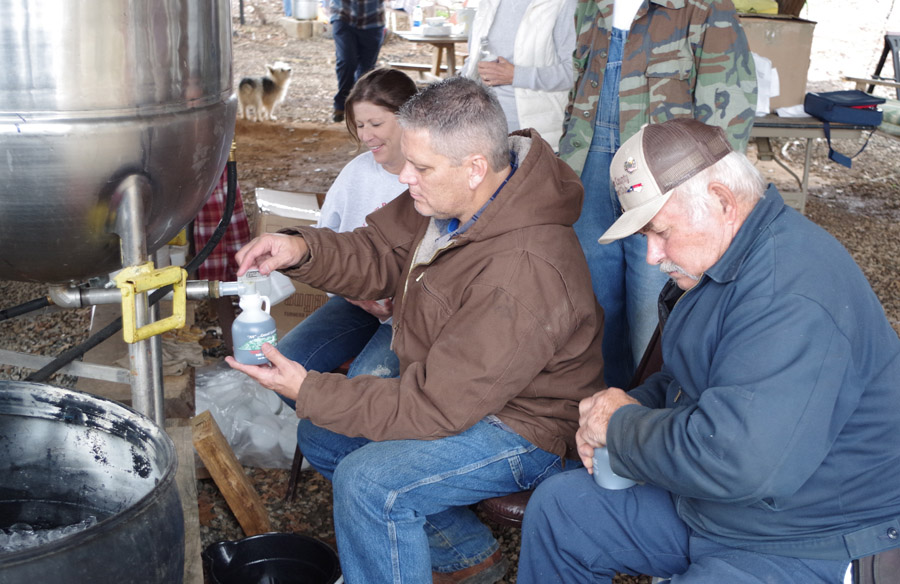
Bradley Fox is shown (center) in this 2017 photo, bottling sorghum syrup with Anita Penland (left) and the late Dale Reese (right).
Joining the Association
Bradley said he first learned about the National Sweet Sorghum Producers and Processors Association (NSSPPA) from fellow sorghum producer Carroll Abernathy. Bradley and Dale joined the Association and became active members.
The Association has yearly meetings in the Pigeon Forge area of Tennessee each February during a three-day event. Members attend from multiple states, including the Carolinas, Kentucky, Tennessee, Georgia, Indiana, Illinois, and Mississippi.
Bradley said the NSSPPA helps further the understanding of sorghum producers in telling best practices and updates on pests, such as aphids.
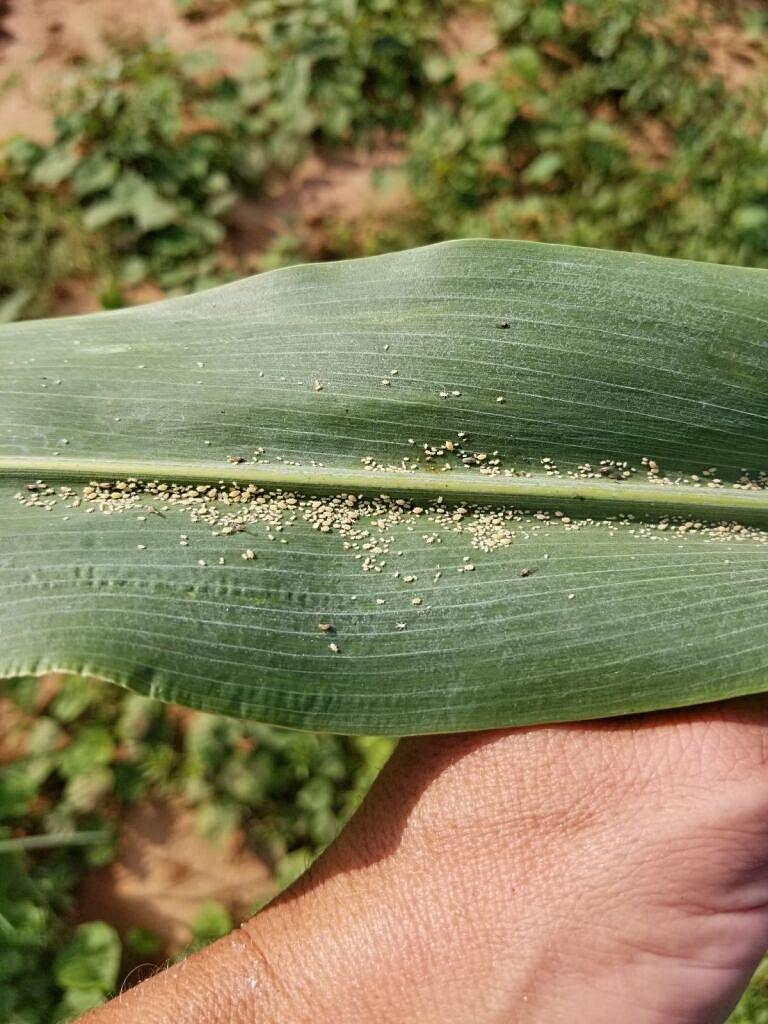
Aphids are a common pest on sorghum.
“We have a chance to fellowship, and I’ve made friends from all over the country,” Bradley explained.
After going to a few meetings, the members voted Bradley in as a Board of Directors member representing North Carolina. Later, he became Association secretary. This year, he was named President following the untimely death of the previous leader.
The NSSPPA annual meeting includes a Sorghum Contest, in which producers bring their best syrups for judging. Local chefs and dignitaries help judge the contest, which draws dozens of entries.
Uses for sorghum syrup
As a sweetener, sorghum syrup can be substituted for sugar in many recipes, including for certain cookies and cakes. It can even be used as a ham glaze, sweetener in baked beans, breads, and candies, and other dishes. “Or, you can just put it on a plate and sop it up with a biscuit,” Bradley said.
Sorghum contains nutrients such as calcium, iron, potassium, and phosphorous.
Other local producers
Among fellow sorghum producers in Alexander County are Aaron Morrison (NSSPPA member), of Hiddenite; Ellendale residents the David Land family, Chris Jolly, George and Billy Herman, Anita Penland and Randy Holbrook (both NSSPPA members); Stony Point residents Robert Haun and Darrell Moose; and the Joe Simmons family of Bethlehem.
Sorghum facts
The NSSPPA notes that a United States patent officer introduced sweet sorghum to America in 1853. It is a native of Africa, a drought-resistant, heat-tolerant member of the grass family. The Department of Agriculture conducted numerous experiments on the extraction of sucrose from sorghum and on crystallization of sorghum syrup. It was hoped to reduce reliance on cane sugar imports and on labor intensive sugar plantations. Farmers in the South and lower Midwest welcomed the cheap, local alternative but it proved too difficult to extract dry sugar from the syrup. However, the syrup continues to be used in many areas of the United States.
Sorghum, like honey, may crystallize, however; putting it in a pan of warm water or putting it in your microwave will restore it to a usable form.
Find out more about sorghum at nssppa.org.





My daddy Ray (Claude) Fox also took us kids to Glade Fox’s to watch molasses being made, way back in the 80’s. I think about that day each time I drive by the location on Liledoun Rd. Wonderful memories of a simpler time. I’ve seen it made one time since, as an adult. I’m glad people my age are carrying on the tradition.
Great article about the full process passed down through multiple generations… Thanks for publishing.