
Will Bethlehem soon be incorporated?

Map excerpt from Alexander County GIS.
By MICAH HENRY and ANGELA FARR KING
The recent discussion of possibly incorporating the Bethlehem Community into a town is something seasoned readers know has been attempted before.
A group is promoting the incorporation of a Town of Bethlehem made up of the Bethlehem 1 and Bethlehem 2 voting precincts, about 23 square miles, and a population of about 7,800 residents. For reference, the Town of Taylorsville is about 2.4 square miles and about 2,300 residents.
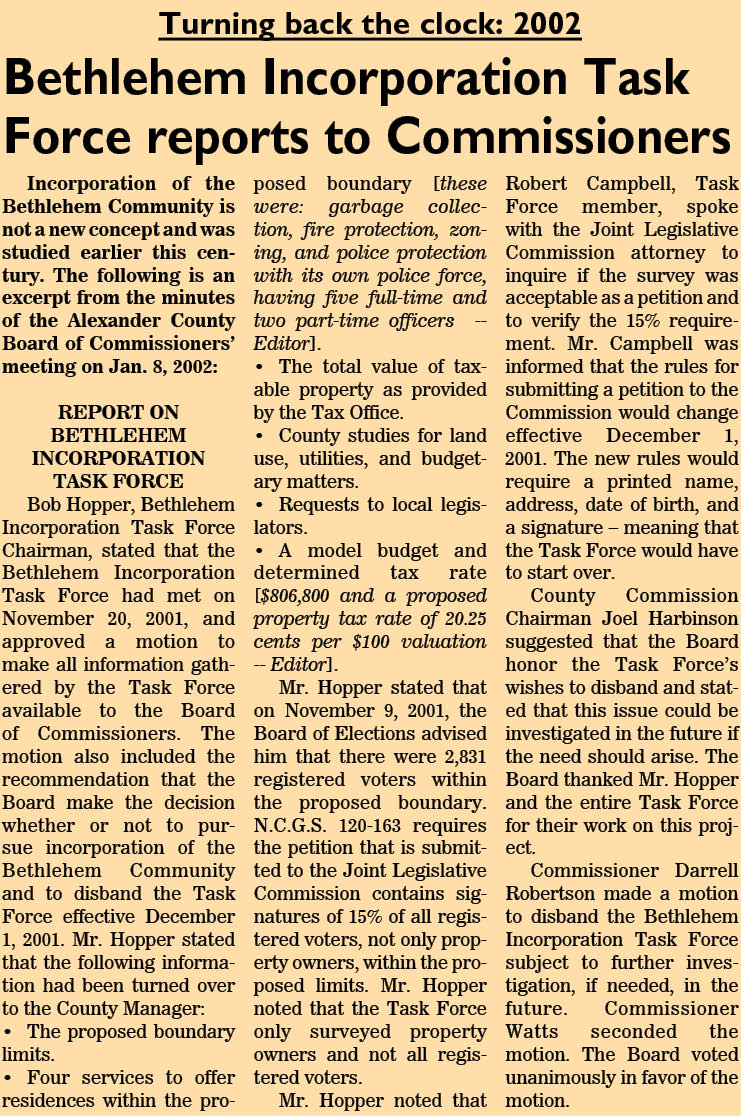
During 2000 to 2002, the Bethlehem Incorporation Task Force study (see sidebar below in tan box) looked at a smaller proposed boundary (12.2 square miles and a population of 5,400) than the current interested parties and reduced it further to 6.7 square miles and a population of 3,236 by the time the study concluded. The Task Force gathered information and mailed out surveys, not petitions, to property owners. This ultimately did not result in an incorporation request to the General Assembly.
In the book Incorporation of a North Carolina Town, authors David M. Lawrence and Kara Millonzi (professors at the UNC School of Government) state, “Under current North Carolina law, a town may be incorporated only by act of the General Assembly… Article VII, section 1, of the state constitution directs that if a community lies within one mile of the limits of an existing city with a population of 5,000 or more, within three miles of a city of 10,000 or more, within four miles of a city of 25,000 or more, or within five miles of a city of 50,000 or more, the General Assembly may incorporate that community only with the approval of three-fifths of the members of each legislative house.”
Arguments in favor of incorporation
Yard signs either promoting incorporation or urging against incorporation have sprung up along roads in Bethlehem, as people become familiar with the issue and express their opinions. Members of both sides recently spoke about their concerns.
One outspoken person in favor of incorporation is Don Taylor, a 14 year resident of Bethlehem. He explained how he became involved in the incorporation issue. In August of this year, Alexander County Planning and Zoning Commission letters were sent to Bethlehem residents, regarding a meeting to occur on a zoning matter for a proposed development called Esplanade – Lake Hickory, a project of housing development firm Taylor Morrison.
“We couldn’t attend [the meeting], we had guests. Our neighbors went and they came back with a huge development plan by Taylor Morrison…I looked at it and said, ‘Wow, I didn’t know they could do that with the current zoning.’ After looking into it a little bit, we then found out, with a few other people, that they completely rezoned the whole county in May with a whole new 2045 Comprehensive Plan, which didn’t have a lot of fanfare with it,” said Taylor.

Don Taylor
“It affects every member of the county. When you read through that, you realize they went away from R-15 or R-20 zoning, what we’re typically used to, which is 1/3 or 1/2 an acre with a house on a nice lot, to what they call Density Based Zoning,” Taylor explained.
“With Density Based Zoning, they’ve gone to what they call R-1 and R-2. Rather than setting aside a lot size, they say if you have a 10 acre lot, and you don’t have any sewer or water, you can put four homes per acre on that lot — 40 homes on a 10 acre lot, anywhere you want to. Cluster them all together, do anything that you want, as long as you can put 40 homes on there with five-foot setbacks on the sides, ten-foot on the front. That is not done per acre anymore; it is done by the size of the lot. If you have sewer and water, you’re allowed eight per acre, so on a 10 acre lot you can put 80 homes on that area.
“If you want to do what they call ‘connected homes,’ which are townhomes or something similar, you can put 16 per acre, or 160 on a 10 acre lot,” Taylor stated. “What that has done, it’s kind of opened the floodgates down in Bethlehem to massive amounts of projects. We have 495 homes going in Esplanade on Rink Dam Road and Bowman Court. There are two other projects discussed in the September 7 [Planning and Zoning] meeting which are another 128 homes going in Wittenburg and another 98 homes going across the street from PJ’s Seafood and the church on Rink Dam Road.”
“A lot of residents here feel it’s going to cause some issues with 721 new homes going in along a 1.25 mile stretch of Rink Dam Road, which currently only has 1,525 homes,” said Taylor. “It’s a 50 percent home increase.”
This development, said Taylor, seems to be at odds with the 2045 Development Plan. Taylor was told the plan will: 1) provide adequate light and air; 2) prevent overcrowding of land; and 3) avoid undue concentration of population, lessen congestion on roads, and secure safety from fire panic and danger.
“All of these projects make all of that worse, so I don’t know how this new land development code, at least in Bethlehem, does that,” Taylor said.
“We tried to do a politically astute route, talk to commissioners, present to commissioners, ask questions. The only other route that we know how to maintain and control zoning is by incorporation. Incorporation will allow us to manage the zoning, the growth, and the commercial district in the Bethlehem area, so we can at least control our own destiny,” Taylor related. “We don’t mind growth. Growth is fine. There’s a lot of retired, elderly people here. There’s a lot of long-time residents here that don’t want to see their community character change that significantly in that short of a period of time, just to generate tax revenue for Alexander County.”
“The county does a great job of providing all the services that we like down here. The only issue we have with them is the land development code that they passed in May. They seem unwilling to make changes to that. If they don’t make changes to that, this area, which does have sewer and water and is very close to Hickory, easy access to the highways, is just going to balloon with houses and change the whole character of the community here. The population growth is something a lot of this community is concerned with.”
He quoted property values at about $1.1 billion assessed tax value in the Bethlehem area, about one-third of Alexander County’s total valuation of $3.3 billion. The 2020 Census shows Bethlehem Voting Districts 1&2 contain about 7,800 people and the county has about 36,000 residents. (The Town of Taylorsville has about 2,300 residents.)
The state requires certain services to be provided by a town. According to Taylor, incorporation of Bethlehem would provide:
• Fire service – through a contract with Bethlehem Fire Department.
• Police – contracted with Alexander County Sheriff’s Office.
• Planning and Zoning – via a combination of town and subcontracting. (Alexander County currently contracts with Western Piedmont Council of Governments for zoning services.)
• Street lighting – which requires the town to manage the power bill for street lighting through assessment and other revenue sevices and does not require any additional lighting to be added.
(Professors Lawrence and Millonzi write that one absolutely mandated service, by state law, that each town must provide for is enforcement of the State Building Code. Most small towns provide this by contracting with the county government or a nearby large city to do building inspections.)
Taylor said the four above services will allow the new Town of Bethlehem to receive the funding required to keep taxes low, at 5 cents per $100 valuation, similar to Connelly Springs and 23 other NC towns. Taylor said this new town tax would amount to $100 per year on a $200,000 home. He said this would generate about $550,000 per year to run the new town. This does not include alcohol tax, sales and use tax, and automotive/highway tax, which the state allocates to municipalities.
Taylor said he understands the large developments are grandfathered in for a period of three years following the County Commissioners’ October 7 vote.
“However, the lions are still at the gates to construct new housing projects which will increase our traffic and change the Bethlehem Community as we know it today,” Taylor indicated.
He and fellow proponents of incorporation have set up a website, www.bethlehemzoning.com.
Arguments against incorporation
Among the citizens against incorporation are husband and wife, Tyler and Christian Brown. Tyler, 40, grew up in the Bethlehem Community and is a businessman here, like his father before him.
The Browns expressed concern that members of the public who are in favor of incorporation do not fully realize the ramifications and expenses involved in Bethlehem becoming a city.
Those against incorporation, including the Browns, have also set up an informational website, www.bethlehemnc.com, which may be accessed via the QR code shown here.
They point to the previous (pre-May 2024) zoning rules and indicate that the Esplanade – Lake Hickory development could also have been proposed under the previous zoning, noting that the main difference was the side setbacks between houses were 8 feet under the old zoning (16 feet between structures) and are 5 feet in the current zoning (10 feet between structures).
Tyler Brown indicated that there is no street lighting in Bethlehem — the only lights are floodlights in privately-owned residential or business lots.
He also noted that some residents have been told that the Esplanade development can be stopped — however, its rezoning was already approved by Alexander County Commissioners.
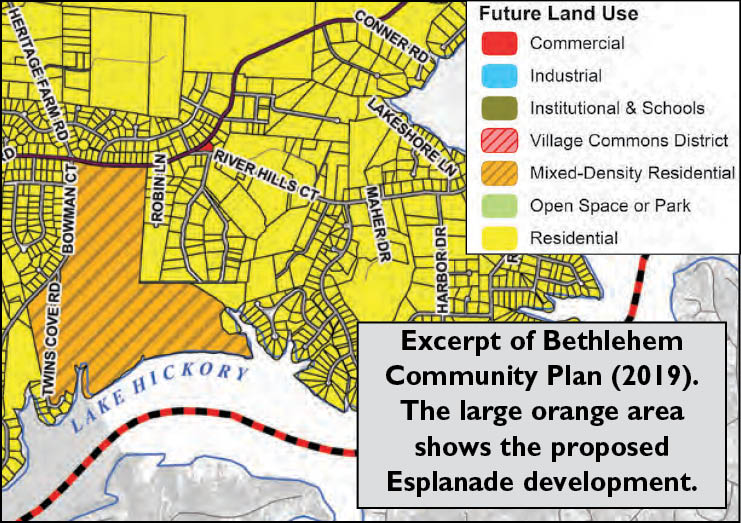
Brown noted that the Bethlehem Community Plan, drawn up in 2019, designated the land just east of Bowman Court, south of Rink Dam Road, for mixed density housing. (This is the land which is now the proposed Esplanade development.) Thus, plans have been in place for five years on this type of housing in that location.
Christian Brown noted that the Bethlehem Park upgrades and the swim beach at Wittenburg Access Area among the positive items which came out of the Bethlehem Community Plan.
Tyler Brown cautioned that incorporation could lead to other city ordinances besides zoning, such as limits on hunting, firearm use, animals, and farming.
Impact on taxpayers across the county and further information
The incorporation of Bethlehem, if completed, would negatively affect the sales tax revenue received by Alexander County Government and the Town of Taylorsville, as some revenue would be diverted to Bethlehem.
Sales tax revenue is distributed on a per capita basis between the county and all municipalities within the county.
Alexander County Government would receive approximately 17.68 percent less sales tax revenue or about $1,694,991.19 (a figure equal to about 4.15 cents per $100 valuation on the county property tax rate, if the loss was remedied by raising County property taxes), stated County Attorney Ben Faulkenberry. He noted that the County is open to negotiation of agreements to provide services to the proposed town of Bethlehem, including law enforcement, building inspections, or other desired services.
The Town of Taylorsville will be impacted by an incorporated Bethlehem to the tune of $170,000 to $200,000 (equal to about 6 to 8 cents per $100 valuation on the Town property tax rate, if the loss was remedied by raising Town property taxes), Town Manager Nathan Hester estimated.
County Commission Chairman weighs in
Josh Lail, Bethlehem resident and Chairman of the Alexander County Board of Commissioners, told The Times, “In my opinion, there is a lot of misleading information being propagated by the group wanting to incorporate Bethlehem, especially pertaining to the cost of a town. The sales tax revenue the ‘Town of Bethlehem’ would receive would be created by splitting what Alexander County already receives. I don’t think Alexander County will continue to provide services to a new town that is taking almost $2,000,000 from the county budget. Not to mention, Alexander County would have to treat the ‘Town of Bethlehem’ and the Town of Taylorsville equally. Taylorsville has a tax rate of $0.35 [per $100 valuation] for a reason. Based on my own research, a new ‘Town of Bethlehem’ would require a similar tax rate. I don’t see any real value in incorporating.”
Recent Bethlehem Community planning
Alexander County signed a contract with the Western Piedmont Council of Governments in July 2018 to provide technical assistance in the development of the Bethlehem Community Plan, in anticipation of the expected growth in the Bethlehem area over the next 5-10 years. The Board of Commissioners also appointed a committee made up of Bethlehem residents and business owners to provide input into the plan’s specifics. The Bethlehem Community Plan Advisory Committee consisted of: Bud Caywood, Andi Jack, then-Commissioner Ryan Mayberry, Fire Chief Ashley Starnes, Betty Long, Jim Price, John Dahlstrom, Randy Bock, Steve Brown, and Susan Osborne. In addition to monthly committee meetings, two community meetings were held to gather input during the planning stage as well as to review the final draft.
This Bethlehem Community Plan was presented to Commissioners in mid-2019 and the Commissioners unanimously approved the plan at their September 9, 2019, public meeting.
The Alexander County 2045 Comprehensive Plan was approved at the April 8, 2024, County Commissioners’ meeting. Prior to this, to gather public input, a series of community meetings was held and an online survey was conducted. The online survey tallied 644 complete responses on a variety of topics that are covered in the new plan. County Planner, Brian Burgess, also presented a draft copy of the Land Development Code. Burgess said that a county must have a comprehensive plan in order to enforce zoning. The new plan was completed in-house with input from the public, a steering committee, and the planning board.
The next month, in May, the Alexander County Board of Commissioners held a public hearing to discuss the draft Land Development Code (LDC) at the May 6 regular meeting. Articles of the LDC include general provisions, zoning district regulations, subdivision regulations, adequate public facilities regulations, landscape design standards, general standards, sign regulations, natural resources, nonconformities, decision-making bodies, review processes and procedures, enforcement/violations/appeals, nuisances, legal status, and definitions. The LDC was unanimously approved.
Next steps
Professors Lawrence and Millonzi note in their book that in most instances, the General Assembly seeks the advice of the Joint Legislative Commission on Municipal Incorporations. Since 1997, the General Assembly have required that almost all incorporation proposals be submitted to and reviewed by the Joint Commission. The Commission must receive, at least 60 days before the next regular legislative session, a petition signed by at least 15 percent of the registered voters in the proposed incorporation area. The Commission must consider the proposed town’s proximity to existing cities, population, nature and degree of development, the proposed municipal services the town will provide, and whether it will be able to provide those services at a reasonable tax rate. At the conclusion of its investigation, the Joint Commission will make either a positive or negative recommendation to the General Assembly. It cannot make a recommendation unless:
• each existing city close enough to the proposed town has expressly approved the incorporation;
• at least 40 percent of the area of the proposed town is in urban development;
• the proposed town has a permanent population of at least 100;
• proponents have submitted with their petition a plan to levy a tax rate of at least 5 cents per $100 valuation and provide at least four of eight specified municipal services and the commission determines the proposed town can provide the requested services by levying a reasonable tax rate.
Taylor noted that his group has enough signatures to proceed but will continue to gather additional signatures and inform the community about reasons for incorporation.
The Browns hope county leaders will host a public meeting with all proposed contracted services to provide more information to residents.






As a relatively new resident in Bethlehem (10 years), I appreciate this in-depth article concerning pros and cons of incorporation. Thanks to Micah Henry and Angela Farr King for excellent reporting.